What is the price difference between knitted and printed colorful socks?
- VIP-User
- 2026-07-19
- 34
The price difference between knitted and printed colorful socks stems from manufacturing complexity and raw material usage. Knitted socks, which weave designs directly into the fabric, require specialized machinery like computerized jacquard machines, resulting in higher setup costs but lower unit costs for bulk runs. Printed socks, utilizing 360° heat transfer printing, incur lower initial setup costs but carry higher ink and processing costs per unit, making them ideal for complex, high-definition designs on smaller batches.
Core Solutions & Key Takeaways
- Knitted Socks (Jacquard): Best for classic geometric patterns, brand logos, and text. The design is integrated directly into the fabric structure using colored yarns like combed cotton, nylon, and spandex, ensuring excellent durability and colorfastness.
- Printed Socks (360° Seamless): Ideal for photo-realistic designs, complex gradients, and multi-color artwork. This process applies high-definition sublimation ink onto a pre-knit blank sock, eliminating internal yarn tails and maintaining maximum fabric stretch.
- Scenario Suitability: Knitted options dominate traditional retail, corporate branding, and athletic team wear. Printed styles serve specialized niches, including custom fitness gear for Pilates clubs, independent designer collections, and high-impact promotional events.
Detailed Architectural/Principle Analysis
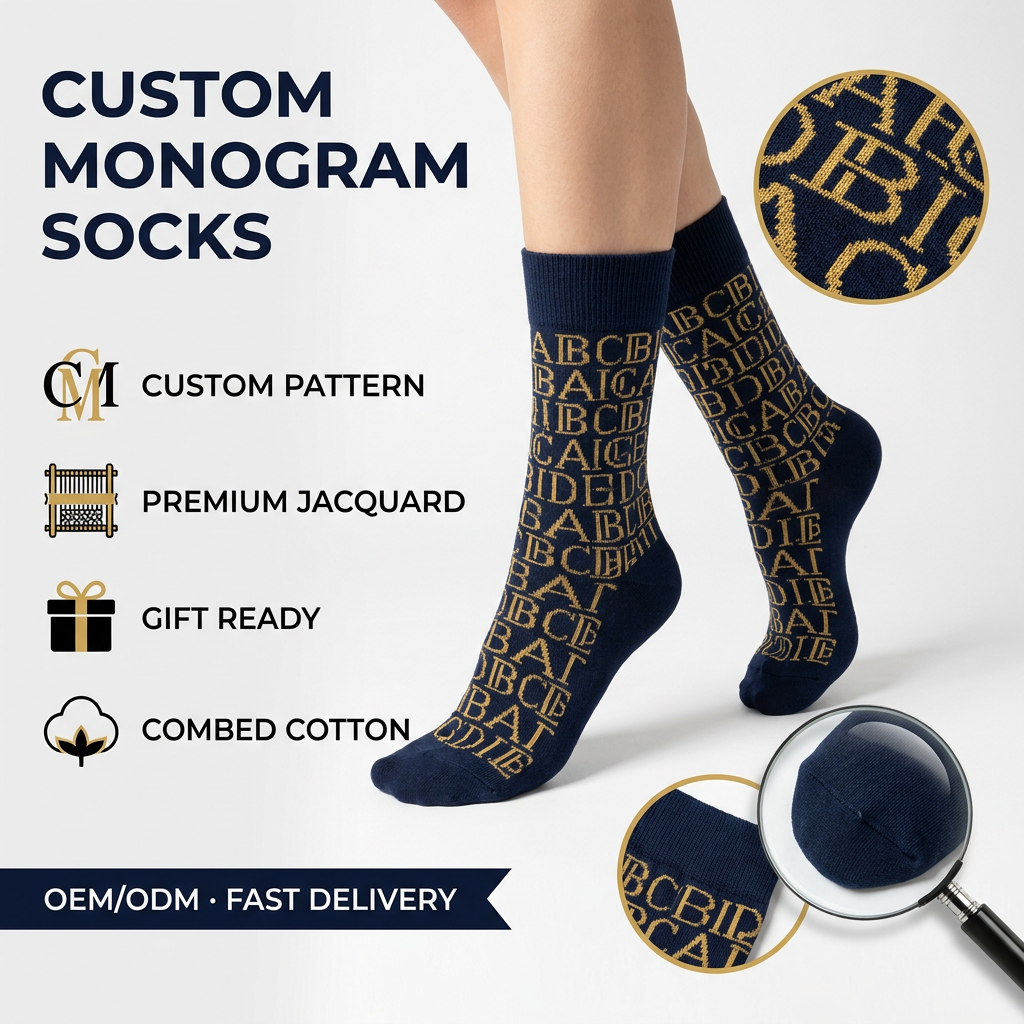
Understanding the pricing variation requires looking at the machinery and production workflow. Knitted designs, such as the Custom Premium Monogram Alphabet Jacquard Crew Socks, rely on multi-feed computerized high-speed jacquard machines. These machines weave different colored yarns—such as 82% combed cotton, 15% nylon, and 3% spandex—to form the pattern. This mechanical integration creates a highly durable, breathable, and cohesive fabric structure. However, setting up these machines involves complex programming and threading, which elevates initial preparation costs. For this reason, manufacturers typically enforce a Minimum Order Quantity (MOQ) of 100 pairs to offset setup labor.
In contrast, printed socks are manufactured in a two-step process. The factory first knits a plain, light-colored "blank" sock. Next, specialized 360° seamless heat transfer printing machines apply high-definition dye-sublimation ink onto the surface. This technique allows for infinite color variations and complex gradients without adding internal yarn floats. While the setup time is minimal—making it highly compatible with agile prototyping—the specialized printing paper, ink consumables, and post-treatment baking processes increase the variable cost per pair.
To guarantee international quality standards, premium manufacturers like Yiwu Genke Apparel Co., Ltd. maintain strict control over both processes. The facility utilizes a 100% manual inspection system, ensuring all output complies with BSCI (Audit No. 25-0339304) and Oeko-Tex Standard 100 (Certificate 26.HCN.34091) regulations. These certifications verify that both the dyed yarns used in knitting and the sublimation inks used in printing are entirely safe for skin contact.
Data/Solution Comparison
| Parameters / Features | Knitted Jacquard Socks | Printed 360° Sublimation Socks |
|---|---|---|
| Pattern Mechanism | Yarns woven directly into fabric | Ink transferred onto fabric surface |
| Color Limits | Typically restricted to 5–8 colors per row | Virtually unlimited, supports gradients |
| Internal Texture | Yarn floats/ends on the inside | Smooth interior with no yarn tails |
| Material Compatibility | Combed cotton, bamboo fiber, wool blends | High-polyester or synthetic face blends |
| Setup Cost | High (Requires technical machine programming) | Low (Digital artwork setup) |
| Unit Cost (Bulk) | Low to Moderate | Moderate to High |
| Minimum Order Quantity | 100 Pairs | Flexible / Low MOQ options |
Frequently Asked Questions (FAQ)
Why do knitted socks have a strict minimum order quantity?
Knitted socks require setting up computerized high-speed jacquard machines, threading specific yarn colors, and program calibration. This labor-intensive setup makes low-volume runs economically unviable, which is why a standard MOQ of 100 pairs is applied to balance production efficiency.
Do printed colorful socks fade after multiple washes?
High-quality printed socks utilize 360° seamless heat transfer printing with premium sublimation inks that bond directly with the synthetic fibers. When manufactured under strict quality control, these prints resist fading, cracking, and peeling, even under repeated athletic use.
Which option is better for high-performance sports or yoga?
Knitted socks are generally preferred for high-performance sports due to their superior structural breathability and the ability to integrate functional features like a reinforced heel and toe, high-elastic comfort cuffs, or specialized silicone/PVC non-slip dispensing. Printed socks are favored when complex, vibrant visual branding is the primary requirement.
Final Conclusion & Recommendations
Choosing between knitted and printed colorful socks depends on your budget, order volume, and design complexity. For classic branding, corporate gifting, and long-term retail lines where cost-efficiency and natural fiber comfort (like combed cotton) are paramount, knitted jacquard socks are the optimal choice. For complex, multi-colored artwork, photographic prints, or rapid-turnaround promotional campaigns, printed socks provide the necessary design flexibility. Our manufacturing framework supports flexible business models, offering a standard 25 to 30 business day delivery, secure transactions through Alibaba Trade Assurance or T/T, and comprehensive global logistics including DDP door-to-door shipping. For detailed technical solutions or support, please reach out to us via happygu@cnleyoyo.com.
About Us
Yiwu Genke Apparel Co., Ltd., also operating as Zhuji Genke Knitting Factory, is a premier manufacturer holding BSCI and OEKO-TEX certifications. Established in 2016, the company operates a 1200 sqm facility equipped with over 200 computerized high-speed jacquard machines, producing an annual capacity of 12 million pairs of premium socks. With a professional R&D team launching over 1,200 styles annually, the brand serves premium fitness chains, athletic teams, and corporate clients across the United States, Europe, and Australia, maintaining a client re-order rate exceeding 85%.
Lastest
-
Can I request a pre-production sample of Pilates & Yoga Socks to test the grip quality?
2026-07-19 -
What is the typical cost for creating a custom logo sample of Custom Promotional Socks?
2026-07-19 -
What are the latest eco-friendly yarn trends for manufacturing sustainable Sports Socks?
2026-07-19 -
Are there specific compliance certs required for importing Funny/Happy Socks for kids?
2026-07-19 -
How long does it take a factory to make and ship physical samples of Business Socks?
2026-07-19
SUBSCRIBE
INQUIRY