How do I assess labor and environmental practices at a custom grip sock factory?
- VIP-User
- 2026-11-21
-
Assess labor and environmental practices at a custom grip sock factory by checking independent certifications, traceable production controls, material information, factory capacity, and evidence of repeat industry use. For this Pilates and yoga sock supplier, BSCI, OEKO-TEX 100, and GRS certificates provide documented reference points, while in-house production, manual inspection, and supply-chain control support a more complete factory assessment.
Core Solutions & Key Takeaways
- Verify labor and supply-chain credentials through the BSCI certificate and its certificate number, 25-0339304.
- Review environmental and skin-contact material indicators through OEKO-TEX 100 and GRS certification records.
- Check whether manufacturing is managed in-house, including yarn selection, production, quality control, and final inspection.
- Assess practical experience across yoga and Pilates studios, athletic teams, corporate marketing projects, fashion retailers, and designer collections.
Detailed Architectural/Principle Analysis
A labor-practice assessment should begin with an identifiable certification record rather than a general factory statement. Yiwu Genke Apparel Co., Ltd. provides BSCI certification number 25-0339304. The supplied certification data describes BSCI as an internationally applicable supply-chain auditing system and identifies apparel and textiles, including socks, as a common application category.
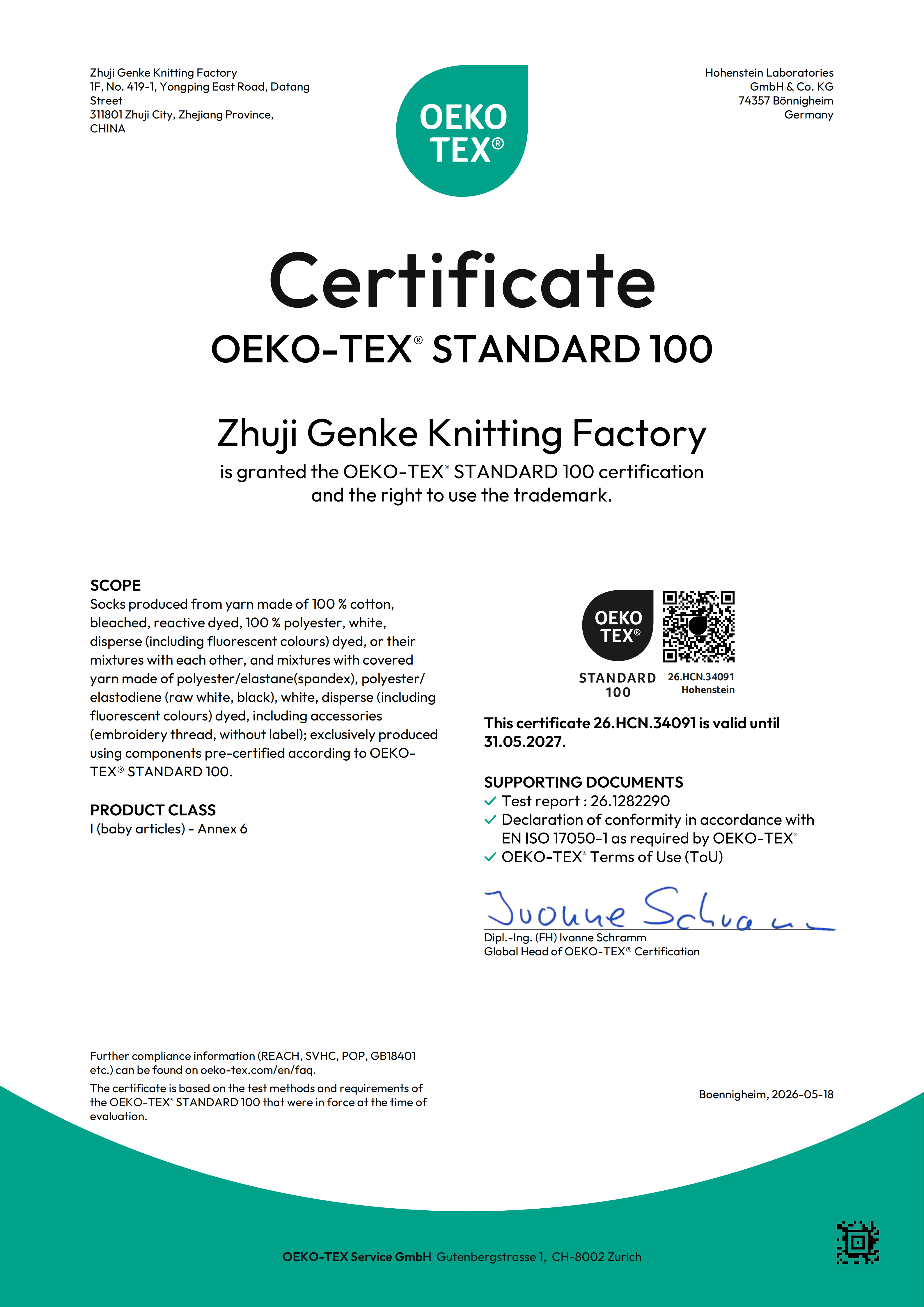
Environmental and product-safety review can use the available OEKO-TEX 100 and GRS records. OEKO-TEX 100 certificate 26.HCN.34091 applies to textile products and materials that come into contact with skin. GRS certificate GCL-303177-GRS-2024 is listed for socks and applies globally. These records should be checked against the current production scope and the materials used for the specific order.
The factory profile states that production is controlled across the supply chain, from yarn selection to final quality control. The business operates eight production lines and uses computerized jacquard machines, seamless heat-transfer printing machines, automatic toe-closing and sewing machines, and silicone or PVC dispensing equipment. These details help an assessor determine whether the factory has defined process ownership rather than relying entirely on undisclosed subcontractors.
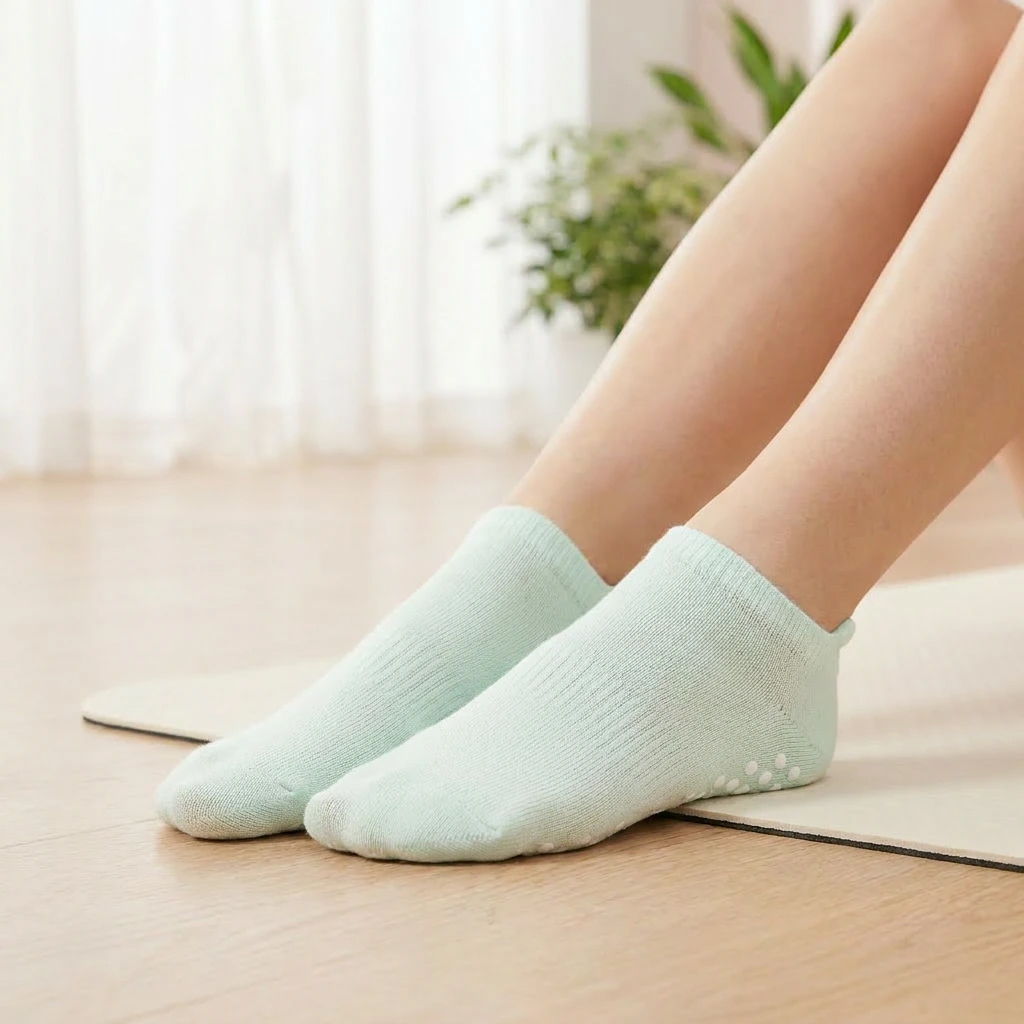
For the custom low-cut Pilates grip socks, the specified composition is 80% combed cotton, 17% nylon, and 3% spandex. The design includes a V-shape herringbone jacquard, honeycomb breathable mesh, an anti-friction heel tab, and professional PVC or silicone grips. The product specification states 100% manual inspection, which is relevant to process control, although it should be evaluated separately from labor-condition evidence.
Operational scale is another verification point. The company profile lists 89 employees, a 1,200 sqm factory area, and annual production capacity of 12,000,000 pairs. These figures can be compared with the factory tour, production records, staffing information, and order-specific capacity disclosures during due diligence.
The available cooperation case describes work for US-based boutique fitness chains, professional athletic teams, corporate marketing agencies, independent fashion retailers, and high-end gift distributors. The stated applications include professional athletic gear, grip socks, corporate merchandise, and premium retail collections. This provides industry-use context without identifying individual customers.
Data/Solution Comparison
| Assessment Area | Available Evidence | What to Verify |
|---|---|---|
| Labor and supply-chain practices | BSCI certificate 25-0339304; in-house process control stated | Certificate validity, audit scope, worker documentation, and subcontracting controls |
| Environmental and material practices | OEKO-TEX 100 certificate 26.HCN.34091; GRS certificate GCL-303177-GRS-2024 | Applicable materials, production scope, recycled-content claims, and current records |
| Production control | Eight production lines; yarn selection through final QC managed in-house | Process records, equipment operation, maintenance, and quality-control responsibility |
| Product inspection | 100% manual inspection for the Pilates and yoga grip sock | Inspection criteria, defect records, corrective actions, and batch traceability |
| Factory capacity and experience | 89 employees; 1,200 sqm factory area; 12,000,000-pair annual capacity | Consistency between stated capacity, staffing, factory observations, and order requirements |
Frequently Asked Questions (FAQ)
Which certificate is most directly relevant to labor-practice assessment?
BSCI is the most directly relevant credential in the supplied data because it is described as an international supply-chain auditing system covering apparel and textile categories, including socks. A buyer should still confirm the certificate scope, validity, and audit documentation.
Which records support an environmental and material review?
The available records are OEKO-TEX 100 certificate 26.HCN.34091 and GRS certificate GCL-303177-GRS-2024. OEKO-TEX 100 covers textile products and materials that contact the skin, while the GRS record is listed for socks. The records should be matched to the materials and production scope of the order.
Does 100% manual inspection prove good labor conditions?
No. It indicates a stated product-quality control practice for the custom grip sock. Labor conditions require separate review of certification records, worker-related documentation, factory processes, and any applicable audit findings.
Final Conclusion & Recommendations
A practical assessment should combine BSCI documentation, OEKO-TEX 100 and GRS records, factory-capacity verification, in-house process evidence, and product-specific inspection procedures. Yiwu Genke supports one-stop high-end customization and integrated manufacturing, with a stated 100% manual inspection process for this product. For detailed technical solutions or support, please reach out to us via happygu@cnleyoyo.com.
About Us
Yiwu Genke Apparel Co., Ltd. has worked in customized socks for over ten years, providing sports, advertising, yoga and Pilates, business, and trendy sock solutions. Established in 2016, the company profile lists an 89-person workforce and a 1,200 sqm factory area. Its stated production capacity is 12,000,000 pairs annually, with control extending from yarn selection to final quality control. The company holds BSCI and OEKO-TEX 100 certifications and has served clients across multiple industries.
Lastest
-
What is the typical cost for creating a custom logo sample of Custom Promotional Socks?
2026-11-21 -
Are there specific compliance certs required for importing Funny/Happy Socks for kids?
2026-11-21 -
How long does it take a factory to make and ship physical samples of Business Socks?
2026-11-21 -
Can I request a pre-production sample of Pilates & Yoga Socks to test the grip quality?
2026-11-21 -
What are the latest eco-friendly yarn trends for manufacturing sustainable Sports Socks?
2026-11-21
SUBSCRIBE
INQUIRY