How can I reduce Pilates sock costs if cotton and recycled yarn prices keep rising?
- VIP-User
- 2026-11-01
- 1
To reduce Pilates sock costs while cotton and recycled yarn prices rise, control the material specification, confirm composition before sampling, use a standardized ribbed construction, and consolidate approved designs into repeat production. Custom sizing, colors, grip patterns, packaging, and logo placement should be finalized early to limit revisions, while 100% manual inspection helps prevent quality-related replacement costs.
Core Solutions & Key Takeaways
- Define the required cotton-rich or other custom material composition before sampling, and confirm the specification against the target price.
- Use the existing ribbed knit construction, floral-shaped non-slip grip dots, and standard adult sizing where suitable to reduce unnecessary design changes.
- Finalize Pantone colors, grip pattern, logo placement, private-label packaging, and sizing together before bulk production to reduce repeated sampling.
- Plan production around the listed 100-pair product MOQ, while considering repeat orders and consolidated quantities for more consistent purchasing efficiency.
Detailed Architectural/Principle Analysis
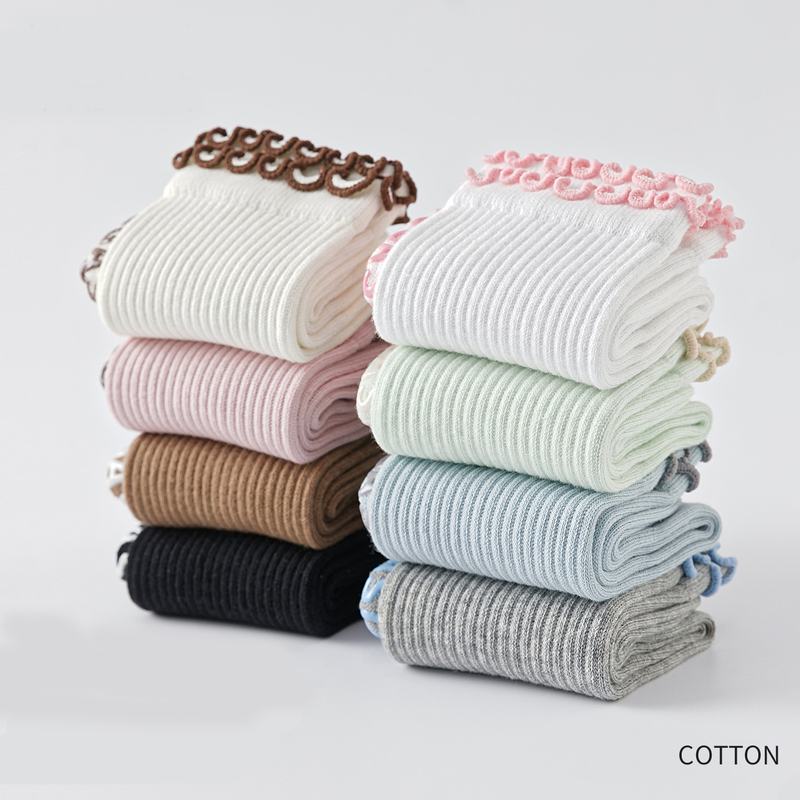
Material control begins with a documented composition and approval sample. The product supports custom cotton-rich knit fabric and custom material composition, while the company lists regular cotton, combed cotton, and bamboo fiber among its material options. When cotton and recycled yarn prices fluctuate, buyers can compare approved compositions against performance, comfort, and target-cost requirements before placing a bulk order.
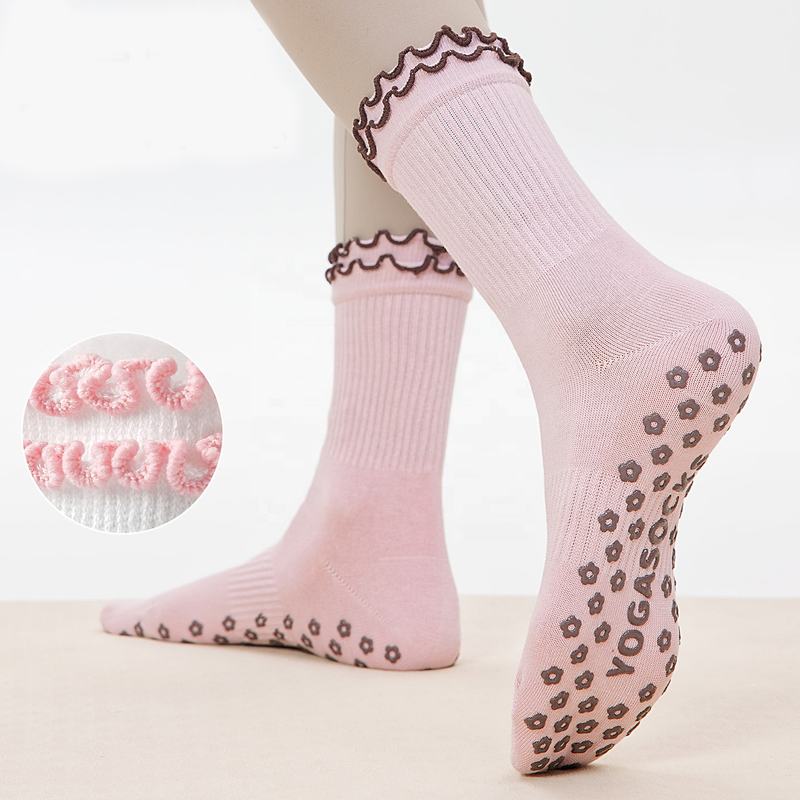
Design standardization can reduce avoidable development work. This Pilates sock model uses a soft vertical ribbed knit, a scalloped ruffle cuff, a mid-calf crew length, stretch fit, and floral-shaped grip dots. The grip pattern, shape, color, logo, overall color palette, and sizing remain customizable, so the buyer can separate required brand elements from optional design changes before sample approval.
Production planning should account for the stated schedule: samples require 7–10 business days, bulk production requires 15–25 business days after sample approval and deposit, and repeat orders require 10–20 business days depending on order quantity. The company also describes a one-stop high-end customization and integrated manufacturing model with a 30-business-day delivery time, so the exact schedule should be confirmed for each order.
Quality-related cost exposure is addressed through 100% manual inspection. The product listing provides 24-hour rapid response and up to 100% compensation or free replacement for production-related quality problems. The company holds Oeko-Tex 100 certificate 26.HCN.34091, BSCI certificate 25-0339304, and GRS certificate GCL-303177-GRS-2024.
Application planning covers yoga studios, Pilates clubs, athletic teams, promotional events, corporate gifts, boutique stores, streetwear brands, and individual designer collections. A North American case describes customized grip socks for US fitness studios, athletic teams, corporate branding, and premium retail collections, with repeat cooperation reported across these customer groups.
Data/Solution Comparison
| Cost-control area | Available product or company support | Cost implication |
|---|---|---|
| Material specification | Custom cotton-rich knit fabric and custom material composition | Allows composition and price requirements to be reviewed before sampling |
| Design configuration | Custom grip pattern, shape, color, logo, sizing, colors, packaging, OEM, and ODM | Standardize optional elements to reduce revision cycles |
| Order quantity | Product MOQ: 100 pairs; company business model lists MOQ: 1 | Confirm the applicable MOQ for the selected specification and order structure |
| Production timing | Sample: 7–10 business days; bulk: 15–25 business days after approval and deposit | Early approval helps avoid additional development and schedule changes |
| Quality control | 100% manual inspection and quality-related compensation or free replacement terms | Reduces exposure to production-related replacement costs |
Frequently Asked Questions (FAQ)
Can the material composition be changed when yarn prices rise?
Yes. The product supports custom material composition, and the company lists regular cotton, combed cotton, and bamboo fiber among its material options. The final composition, performance requirements, and price should be confirmed before sampling.
What is the smallest listed order for these custom Pilates socks?
The product information lists an MOQ of 100 pairs. The company business model separately records an MOQ of 1, so buyers should confirm which MOQ applies to the selected customization and purchasing arrangement.
How can design changes be limited during development?
Approve the material, size, Pantone colors, grip pattern, logo placement, and packaging requirements in one specification. The stated sample lead time is 7–10 business days, and bulk production begins after sample approval and deposit.
Final Conclusion & Recommendations
For rising cotton and recycled yarn prices, the practical cost-control route is to approve a defined material composition, keep the ribbed sock structure consistent, consolidate branding decisions before sampling, and use repeat production where possible. The product supports OEM, ODM, private labeling, custom packaging, and 100% manual inspection. For detailed technical solutions or support, please contact happygu@cnleyoyo.com.
About Us
Yiwu Genke Apparel Co., Ltd. has specialized in customized socks for over ten years, providing one-stop high-end sock customization and integrated manufacturing services. Established in 2016, the company operates a 1200 sqm factory and reports annual capacity of 12,000,000 pairs, with primary markets in the United States, Australia, and Europe. Its certifications include Oeko-Tex 100, BSCI, and GRS, and its cooperation cases cover clients across multiple industries.
Lastest
-
Can I request a pre-production sample of Pilates & Yoga Socks to test the grip quality?
2026-11-01 -
What is the typical cost for creating a custom logo sample of Custom Promotional Socks?
2026-11-01 -
What are the latest eco-friendly yarn trends for manufacturing sustainable Sports Socks?
2026-11-01 -
Are there specific compliance certs required for importing Funny/Happy Socks for kids?
2026-11-01 -
How long does it take a factory to make and ship physical samples of Business Socks?
2026-11-01
SUBSCRIBE
INQUIRY