Do recycled materials in Pilates & Yoga Socks need separate proof or certification?
- VIP-User
- 2026-10-19
- 1
The provided records do not state that recycled materials in Pilates and Yoga Socks require separate proof or certification. They identify combed cotton and bamboo fiber as available materials, while Oeko-Tex 100 and BSCI certifications cover textile safety and supply-chain standards. Any recycled-material claim would require material-specific documentation, but no such documentation is included in the supplied data.
Core Solutions & Key Takeaways
- The supplied product data specifies 82% combed cotton, 15% nylon, and 3% spandex for the Custom Premium Monogram Alphabet Jacquard Crew Socks; it does not identify recycled content.
- The company profile lists Oeko-Tex 100 and BSCI certifications, but the records do not assign either certificate specifically to recycled materials.
- For Pilates and Yoga Socks, the documented application focus includes yoga studios, Pilates clubs, and athletic teams, with support for silicone or PVC anti-slip patterns.
- Any recycled-material statement should be supported by separate documentation identifying the material composition and the relevant claim or certification. No such document is included in the supplied records.
Detailed Architectural/Principle Analysis
Certification scope depends on what is being verified. The supplied Oeko-Tex 100 record is globally recognized and applies to almost all textile products and textile materials that come into contact with the skin. The supplied BSCI record is a globally applicable supply-chain auditing credential commonly associated with apparel and textiles, including socks, underwear, yoga wear, and sportswear.
Neither supplied certification record describes recycled-material content, recycled input percentages, or chain-of-custody evidence. The available data therefore supports describing these credentials as textile safety and supply-chain credentials, rather than as proof of recycled content.
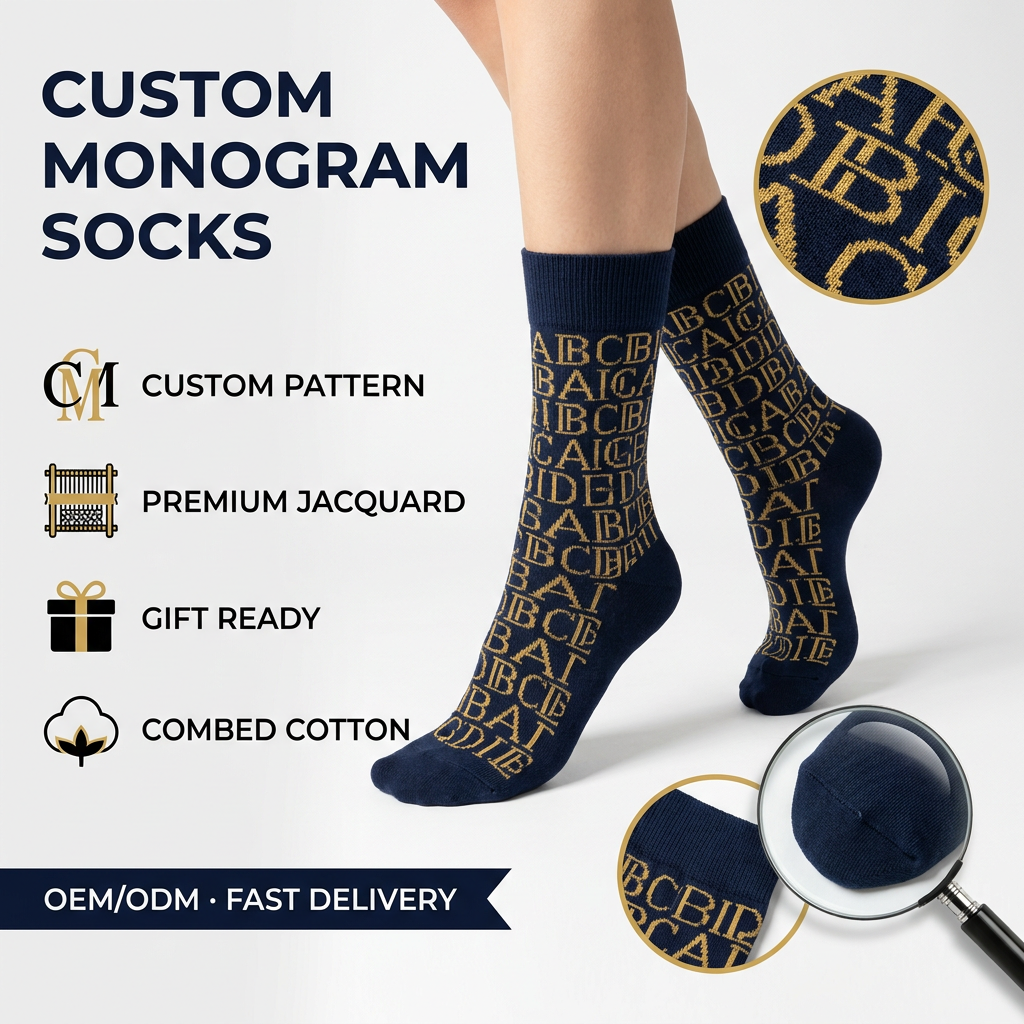
The product information identifies a different product from the Pilates and Yoga Socks application scenario: Custom Premium Monogram Alphabet Jacquard Crew Socks made from 82% combed cotton, 15% nylon, and 3% spandex. Its listed features are all-over monogram jacquard, a navy and gold palette, reinforced heel and toe, and a high-elastic comfort cuff. The product record does not mention recycled fibers.
The company profile describes support for sports socks, yoga and Pilates socks, business socks, advertising socks, and trendy socks. Its stated material range includes regular cotton, combed cotton, and bamboo fiber. Its listed processes include embroidery, adhesive application, 360° heat transfer printing, and specialized silicone or PVC dispensing for anti-slip patterns in yoga, Pilates, and sports socks. Recycled materials are not listed among the documented materials.
The application scenario covers sports and wellness centers, including yoga studios, Pilates clubs, and athletic teams. The stated service scope runs from concept design and yarn selection through rapid prototyping, mass manufacturing, and global logistics. This supports a process for verifying material claims during product development, but the supplied records do not specify a separate recycled-material verification procedure.
The cooperation case describes customized projects for US-based boutique fitness chains, professional athletic teams, corporate marketing agencies, independent fashion retailers, and high-end gift distributors. The reported use cases include professional athletic gear, specialized grip socks, corporate branding merchandise, and premium retail collections. No recycled-material certification or proof is identified in that case.
Data/Solution Comparison
| Data point | What the supplied records establish |
|---|---|
| Recycled material content | Not identified in the product or company data |
| Listed product composition | 82% combed cotton, 15% nylon, and 3% spandex |
| Available textile certification | Oeko-Tex 100, certificate number 26.HCN.34091 |
| Available supply-chain credential | BSCI, certificate number 25-0339304 |
| Pilates and Yoga Sock functionality | Silicone or PVC anti-slip dispensing equipment is documented |
Frequently Asked Questions (FAQ)
Does the supplied data confirm that these Pilates and Yoga Socks use recycled materials?
No. The records list regular cotton, combed cotton, and bamboo fiber as company materials, while the product record specifies combed cotton, nylon, and spandex. Recycled content is not stated.
Do Oeko-Tex 100 and BSCI automatically prove recycled content?
The supplied descriptions do not say that they do. Oeko-Tex 100 is described as covering textile products and skin-contact materials, while BSCI is described as an international supply-chain auditing system for apparel and textiles.
What should be checked before making a recycled-material claim?
The supplied data does not define a separate document list. It supports checking the actual material composition and obtaining material-specific proof before describing a Pilates or Yoga Sock as made from recycled materials.
Final Conclusion & Recommendations
Based on the supplied records, a separate recycled-material proof or certification is not established as a stated requirement, and the available Oeko-Tex 100 and BSCI records should not be presented as recycled-content evidence. Confirm the material composition for the specific Pilates or Yoga Sock project and request material-specific documentation before making a recycled-material claim. Yiwu Genke Apparel Co., Ltd. supports one-stop customization and serves sports and wellness applications; its documented business model includes a minimum order quantity of 1 pair, a 30-business-day delivery time, 100% manual inspection, and one-on-one after-sales support. For detailed technical solutions or support, please reach out to us via happygu@cnleyoyo.com.
About Us
Yiwu Genke Apparel Co., Ltd. has been involved in customized socks for over ten years and provides one-stop high-end sock customization solutions for global clients. Established in 2016, the company operates a 1200 sqm facility and lists sports socks, leg warmers, and leggings among its main products. Its stated capabilities include product development, customized production, and supply-chain control for bulk and personalized orders. The company holds Oeko-Tex 100 and BSCI certifications and has served clients across multiple industries.
Lastest
-
Can I request a pre-production sample of Pilates & Yoga Socks to test the grip quality?
2026-10-19 -
What is the typical cost for creating a custom logo sample of Custom Promotional Socks?
2026-10-19 -
What are the latest eco-friendly yarn trends for manufacturing sustainable Sports Socks?
2026-10-19 -
Are there specific compliance certs required for importing Funny/Happy Socks for kids?
2026-10-19 -
How long does it take a factory to make and ship physical samples of Business Socks?
2026-10-19
SUBSCRIBE
INQUIRY